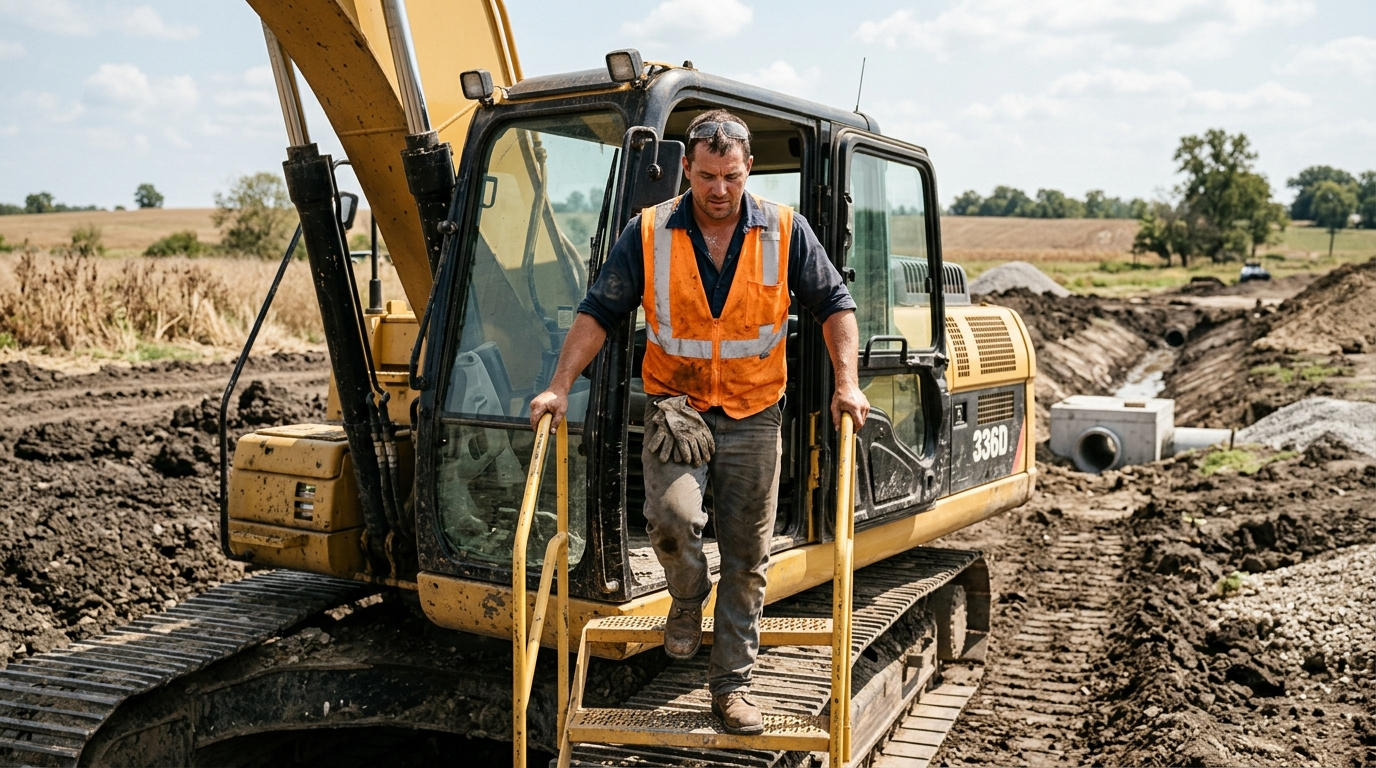
Illinois workers compensation requirements: what every employer needs to know
If you run a business in Illinois and have even one employee, Illinois workers compensation requirements apply to you. No exceptions for small shops, no grace period for new hires. The Illinois Workers' Compensation Act is one of the broadest mandatory coverage laws in the country, and the penalties for non-compliance are steep enough to put a small business under. Whether you operate a construction crew in Marion, a restaurant in Carbondale, or a retail shop in Mount Vernon, here is what you need to understand before your next payday.
Who must carry workers compensation in Illinois
Illinois law requires virtually every employer to carry workers compensation coverage from the moment they hire their first employee. The law covers full-time workers, part-time workers, seasonal workers, and in many cases even family members on the payroll. There is no minimum headcount that triggers the requirement. One person working for pay is enough.
A few narrow categories are exempt. Sole proprietors with no employees are not required to cover themselves, though they can elect to do so. Corporate officers of closely held corporations may exclude themselves under specific conditions. Agricultural employers have some limited exemptions depending on the size of their operation. Outside these carve-outs, if someone works for you and gets hurt on the job, Illinois expects coverage to be in place.
Independent contractors are a common gray area. Many Illinois businesses assume that classifying workers as 1099 contractors removes their exposure. The Illinois Workers' Compensation Commission looks past labels and examines the actual working relationship. If the worker follows your schedule, uses your tools, and works exclusively for you, the Commission may treat that person as an employee. Misclassification is one of the most common reasons employers face liability they thought they had avoided.
What the coverage actually pays for
Workers compensation is a no-fault system. An injured employee does not have to prove negligence, and the employer cannot defend a claim by pointing to the employee's own carelessness (with very limited exceptions). If the injury happened in the course of employment, the insurance pays.
Coverage falls into several categories:
- Medical benefits: All reasonable and necessary medical treatment, including emergency care, surgery, physical therapy, prescriptions, and follow-up appointments, with no dollar cap in Illinois.
- Temporary total disability (TTD): Wage replacement while the employee cannot work at all, paid at two-thirds of the worker's average weekly wage, up to a state-set maximum that adjusts annually. For 2024, the maximum TTD rate is $1,897.92 per week .
- Temporary partial disability (TPD): Wage replacement when the employee returns to lighter duty at reduced pay, covering two-thirds of the difference between pre-injury and current wages.
- Permanent partial disability (PPD): Compensation for lasting impairment to a specific body part or function. Illinois uses a body part schedule (loss of a hand, for example, carries a specific number of weeks of compensation) plus a "wage differential" method for more complex cases.
- Permanent total disability (PTD): Lifetime benefits for workers who cannot return to any gainful employment.
- Death benefits: Payments to surviving dependents, plus up to $8,000 in funeral expenses under current Illinois law.
Penalties for operating without coverage
The Illinois Workers' Compensation Commission does not treat non-compliance lightly. Employers who operate without coverage face fines of $500 per day for each day they lacked insurance, with a minimum fine of $10,000 . The Commission can also issue a stop-work order, shutting down business operations until coverage is secured.
Beyond the regulatory fines, an uninsured employer whose employee is injured on the job is personally liable for every dollar of medical costs, wage replacement, and disability benefits that workers compensation would have covered. A single serious injury, a broken leg, back surgery, or a crushing injury on a farm or job site, can generate $100,000 to $500,000 or more in total claims costs. That exposure falls directly on the business owner when no policy is in place.
Illinois also publishes a public list of employers who have received stop-work orders. For a small business in a community like Harrisburg or Du Quoin, that kind of public record can do lasting damage to your reputation.
How Illinois workers compensation rates are calculated
Premiums are based on three main factors: your industry classification (job codes with assigned base rates), your total payroll, and your experience modification factor (also called the "e-mod" or "mod").
Every type of work gets a classification code. A clerical office worker carries a much lower rate than a roofer or a grain elevator operator. If you have employees doing multiple types of work, each hour of payroll is assigned to the appropriate code. Misclassifying employees into cheaper codes is considered premium fraud, so accuracy matters.
The experience modification factor compares your actual claims history against the expected claims for a business of your size and industry. A clean loss history earns a mod below 1.0, which reduces your premium. A history of frequent or severe claims pushes your mod above 1.0 and increases your cost. For newer businesses that have not yet accumulated three years of claims history, a default mod of 1.0 applies.
A simplified example: a landscaping company in southern Illinois with $500,000 in annual payroll and a class code rate of $8.00 per $100 of payroll would have a base premium of $40,000. With a 0.85 mod (good loss history), the actual premium drops to $34,000. With a 1.20 mod (poor loss history), it climbs to $48,000. Controlling claims through workplace safety programs is one of the most direct ways to manage insurance costs over time.
Obtaining coverage: your options in Illinois
Most Illinois employers purchase workers compensation through a licensed private insurance carrier. Because Illinois is a competitive state market rather than a monopoly state fund, multiple insurers compete for your business, and rates can vary significantly from one carrier to the next for the same payroll and class codes. Working with an independent insurance agency lets you shop your account across multiple carriers and compare price, coverage terms, and carrier financial strength.
A second option is a Professional Employer Organization (PEO), where your employees are co-employed by the PEO, which carries its own master workers compensation policy. This can work well for some small businesses, but it comes with trade-offs in control and cost structure that deserve careful evaluation.
Large employers with strong balance sheets can also self-insure, but Illinois requires formal approval from the Workers' Compensation Commission, a security deposit, and ongoing financial reporting. Self-insurance is not a realistic path for most small to mid-size businesses.
If you are having trouble finding coverage in the standard market because of a high mod or unusual operations, Illinois has an assigned risk pool called the Illinois Workers' Compensation Insurance Plan (IWCIP). Coverage through the assigned risk pool is typically more expensive than the voluntary market, so it is a last resort. An experienced agent can often find voluntary market options that keep you out of the pool.
Special considerations for southern Illinois industries
The industries common to southern Illinois carry workers compensation exposures that deserve a closer look. Agriculture, construction, trucking, grain handling, and manufacturing each have distinct risks.
Farm employers in Illinois are partially exempt from mandatory coverage if they employ fewer than 400 days of agricultural labor per quarter, but this exemption is narrower than many farmers assume. Any non-agricultural employee on a farm operation is covered by the general rules. Farms with employees driving vehicles, operating equipment, or handling livestock year-round are often well over the threshold. The consequences of a serious farm injury without coverage are severe.
Excavating and construction contractors face some of the highest class code rates in the state because of the physical hazards involved. General contractors also need to understand that if a subcontractor they hire does not carry its own workers compensation, the general contractor can be held liable for injuries to that subcontractor's workers under Illinois law. Requiring certificates of insurance from every subcontractor before work begins is financial self-protection, not just good practice.
For a broader look at protecting your Illinois business across multiple coverage lines, the Illinois small business insurance guide covers the full picture of what most operations need. And if your business has commercial vehicles, keep in mind that commercial auto insurance is a separate coverage that works alongside workers compensation, not in place of it.
What to do after a workplace injury
How you handle the first 24 to 48 hours after a workplace injury shapes the entire claims outcome. Illinois employers should have a clear internal procedure in place before an accident happens.
- Get the employee medical attention immediately. In a non-emergency, Illinois allows employers to direct employees to a designated treating physician for the first visit. After that, the employee has the right to select their own doctor.
- Report the injury to your insurer promptly. Most policies require notice within a specific timeframe. Late reporting can complicate claims and occasionally result in coverage issues.
- Document the incident thoroughly. Witness statements, photos of the scene, and a written incident report all help establish the facts while details are fresh.
- Stay in communication with the injured worker. Employees who feel ignored after an injury are more likely to hire attorneys and pursue contested claims. A straightforward, compassionate response often leads to faster, less expensive resolution.
- Explore return-to-work options. Offering modified duty while an employee recovers reduces TTD payments and keeps your e-mod from rising unnecessarily.
Get the right coverage for your Illinois business
Workers compensation is not an optional line item. It is a legal requirement, a financial safeguard, and a basic obligation to the people who show up and do the work every day. Getting it right from the start, with the correct classifications, adequate limits, and a carrier that understands your industry, makes a real difference when a claim happens.
At Zirkelbach Insurance Agency, we are an independent agency serving employers across southern Illinois, from Marion and Centralia to Harrisburg, Carbondale, and beyond. We work with multiple carriers, which means we compare options on your behalf rather than locking you into one company's rates. We can review your current workers compensation setup, identify classification issues, and help you understand what you are actually buying.
To get started or ask questions about your current coverage, visit our workers compensation insurance page or contact us online to speak with an agent. You can also call us directly at (618) 313-7001 . We are here to make sure you are covered correctly, not just covered on paper.